


We’ve been conditioned to believe that the best possible way to make decisions is being “data-driven.” We’re told that if we can’t track it in a spreadsheet, it doesn’t exist. We obsess over rates, billable hours, and overhead costs, tracking every metric to ensure our income and expenses meet our goals.
But have you ever signed a client or job opportunity that checked every “good decision” box on paper, only to feel a pit in your stomach the moment you took a moment alone?
That’s your internal system flagging a qualitative data point your spreadsheet missed.
The reality is that we don’t exist solely as sets of figures. Designing and running your work life as if you are a calculator is a sure path to burnout. To build a sustainable freelance consulting practice, you don’t need to choose between numbers and feelings.
You need to learn how to let them talk to each other.
The Role of Numbers: Your Guardrails
Numbers can provide the objective truth of your business (but not the whole truth). They represent the “what.” Without them, you aren’t running a business; you’re running a hoppy that is fueled by hope. If you want your practice—or career pivot—to be sustainable it has to pay the bills.
Numbers help you strip away the stories we all tell ourselves about success. A few cases in point, based on my own recent experience:
I felt like I incredibly busy, but my time tracker pointed out that I was actually really underbilling my time and had space to take on another client.
I had a sinking feeling that one service area was dying out, but my numbers helped me see that what I was experiencing was a typical seasonal lull that will likely pick up.
I felt like no one was reaching out, but my pipeline showed that I was managing more possible opportunities than before.
In my NEW planning toolkit, I emphasize tracking a few simple metrics like:
Net Profit: What are you actually bringing in, after expenses?
Lead Source: Where are your best-paying, least-stressful clients coming from, and how many hooks do you actually have in the water?
Capacity: Exactly how many hours do you have left before the quality of your output starts to tank?
Numbers keep you solvent. They ensure that the lights stay on.
The Role of Feelings: Your Compass
If data is the “what,” feelings are the “why.” Feelings pick up on the nuances that a CRM can’t see—like the tone of a client’s email or the way your energy levels plummet when you see a specific meeting on your calendar.
In freelancing, your “gut” is actually just a very fast processor of qualitative data:
The Sunday Scaries: If you feel dread on Sunday night, the numbers don’t matter. A “profitable” project that makes you miserable is a failed project.
The Friction Point: If a simple onboarding process feels like pulling teeth, the “data” of the contract doesn’t matter—the relationship is already over-leveraged on effort.
Alignment: Does this work actually make you feel like the “Boss” you set out to be, or are you just building a new job for yourself with a worse boss?
Feelings keep you sane. They ensure that you actually enjoy the life your numbers are paying for.
The Sweet Spot: The Integration Matrix
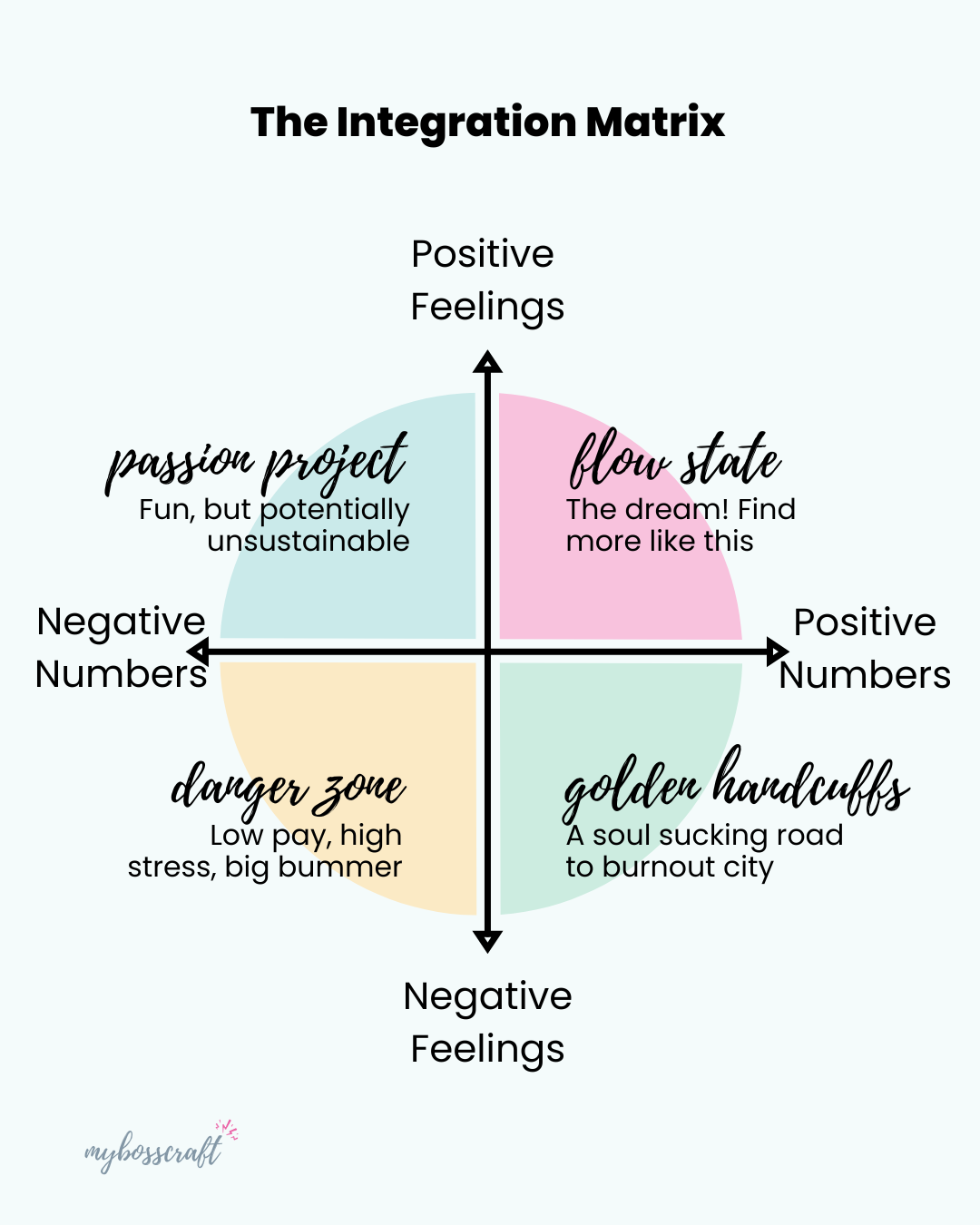
To find the right balance, I like to look at my work as though it’s sitting at the intersection of the “data” axis and the “feelings” axis.
There is a spectrum between projects that come with positive data (good money, good hours, important clients) and those that demonstrate negative data (low rates, ongoing problems, other bummers), just as there is a spectrum between projects that come with positive feelings (great teams, fun work, fullfilling outcomes) and those with negative feelings (miserable teams, unfullfilling work, actively doing things you hate).
When you’re sitting in each of these quadrants on the spectrum, you get a general outcome:
Negative feelings + negative data = the danger zone. Low pay, high stress, basically a constant bummer (and a client you need to fire asap).
Negiatve feelings + positive data = the golden handcuffs. High pay or prestige factors, but you had what you’re doing or who you’re doing it for. A challenge to unload, but a definite road to burnout if you stay on it too long.
Positive feelings + negative data = the passion project. Not a bad thing inherently, but insufficient pay or bad processes can lead to resentment, if you don’t accept this for what it is.
Positive feelings + positive data = the flow state. Getting paid what you’re worth to do work you love doing with folks you love doing it for? The dream. Also, my definition of what makes an “ideal client.”
The Verdict
The most successful consultants I know aren’t just math whizzes or “vibes” people—they are bilingual. They speak the language of profit and the language of intuition.
If the numbers say “Yes” but your gut says “No,” listen to your gut. It’s usually seeing a red flag that hasn’t hit the balance sheet yet.
But if your gut says “Yes” and the numbers say “No,” listen to the numbers. They are trying to save you from a “passionate” path toward bankruptcy.
The goal isn’t to be one or the other. The goal is to be both.
Your planning efforts should reflect that balance between the numbers and the feelings. That’s why I’m so happy with the newly revamped Boss Insights Reflection and Planning Toolkit. It’s my happy medium with both sides speaking volumes.