


Last year was a masterclass in uncertainty. When the ground feels shaky—or like it’s been completely swept from under you—our brains revert to some seriously non-strategic thinking. If you literally don’t know where the next rent payment is coming from and you’re seeing your savings dwindle every month, it becomes impossible to make the best choice for the long term.
We start hording opportunities like they’re the last canned goods on the shelf before an impending storm.
This is a totally natural instinct. We’re clutching at straws. Every job posting, every lead, every “quick coffee,” every low-priority project. We say “yes” because “yes” feels like our chance to get back to safety.
But somewhere in our wisest self, we know that this is a bad move. We’ve probably read the research. Hell, we might have even written the book on building resilience. (Or at least a lot of funding proposals.)
Unfortunately, our stupid human brains don’t always do what we would like them to do. Sometimes we do the less-than-optimal thing because we’re just humans.
When we finally move into a new season, whatever safety we cobbled together starts to feel like a straightjacket.
If you’re feeling heavy, it might not be because you’re not doing enough work to find sustainability. It might just be that you’re doing too much of the work that was only meant to be temporary.
The Scarcity Hangover
Last year taught many of us to operate from a place of “just in case.”
We took the client that didn’t quite fit our values because the bank account said we should.
We said yes to the fancy freelance gig that was slightly out of our wheelhouse because we weren’t sure when the next one would come.
We took the job that was “good enough” for right now.
We said yes to the "quick coffee" that turned into a two-hour unpaid consulting session because we didn't want to "close a door."
The danger of the scarcity mindset isn't just that it makes us tired; it's that it makes us undiscriminating. When you are starving for security, everything looks like a feast—even the projects that are actually poisonous to your long-term goals.
Let’s give your past self some credit: that was a survival skill. You needed it. But do you still? Because you won’t be happy if you continue to subsist in survival mode.
Explosing the phantom fears is a critical step in preparing to retool your professional life. When we are back in the driver's seat, choosing to stop—choosing to say "no"—typically hits three pretty common fears:
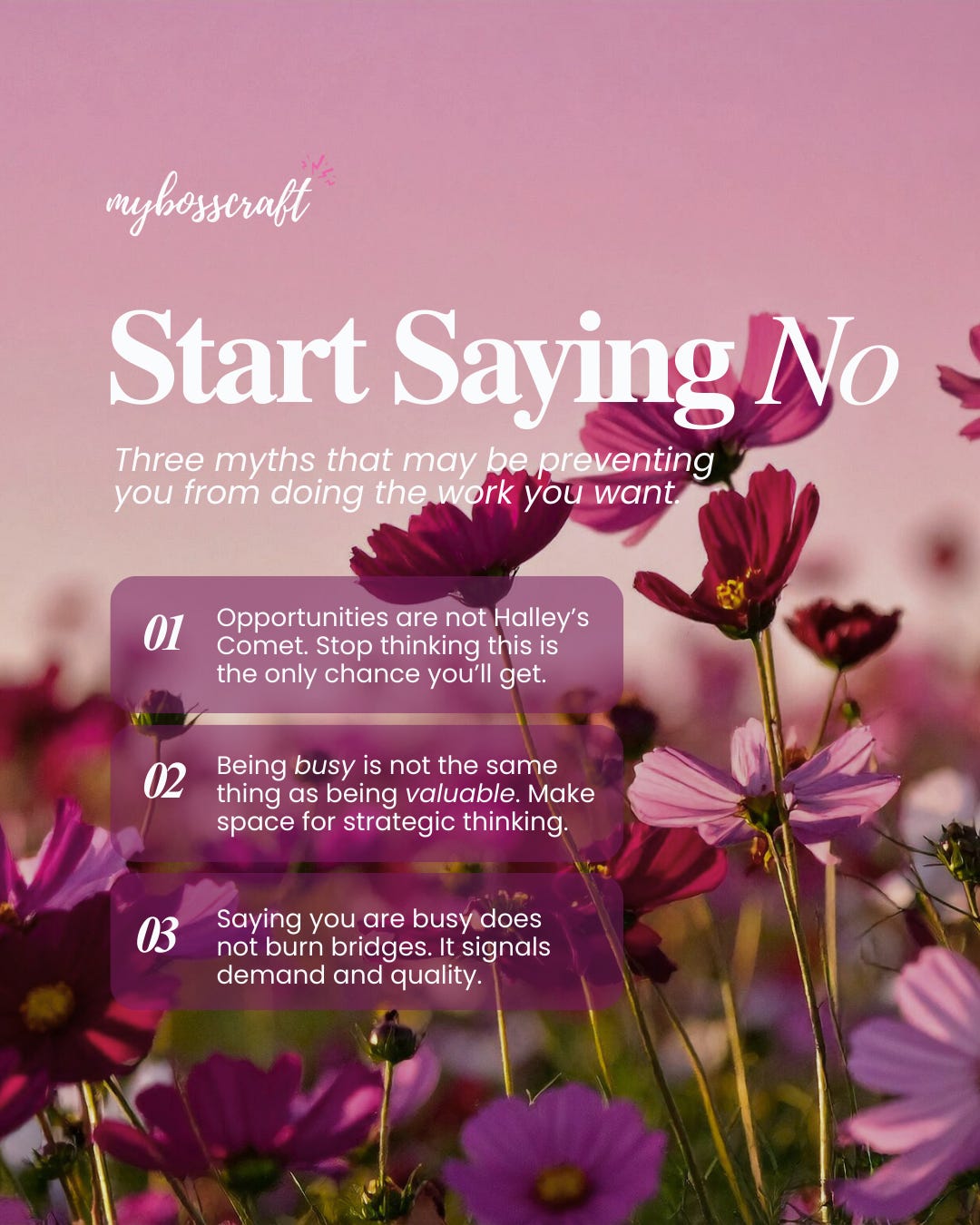
1. The “Vanishing Opportunity” Myth
When we operate from scarcity, we believe opportunities are like Halley’s Comet: if we don’t grab this one, we won’t see another for 75 years. We fear that saying no to a “mediocre” client (or employer) today means the “ideal” client will never find us.
Reality Check: There are opportunities out there. You find them by investing time in meeting with the right people and spending time on marketing yourself. When you say “yes” to the wrong thing, it will actually force a “no” for the right thing by stealing both your capacity to do that marketing leg work and accept the ideal assignment when it materialized. You won’t have time to do the work you want to do most if you say yes to something you kinda hate today.
2. The Identity Crisis (The “Useful” Boss)
Many of us have built our self-worth on being the “fixer” or the “yes-person.” We worry that if we start setting boundaries, people will stop seeing us as high-performers. We confuse being busy with being valuable. Your classic people-pleasing behavior in which the person you strive to please never seems to be you.
Reality Check: As I noted in Thinking Like a Boss, true leadership requires firing yourself from the weeds. You cannot make time for the meaty work that you want to be doing if you allow every “quick ask” that comes your way to form a bottleneck. This also goes for having filled your week with 100% billable hours. You cannot think about longer-term strategy if you have no time or energy to do so.
3. The “Bridge Burning” Anxiety
We are terrified that a “no” is an insult. We think, “If I tell this person I don’t have the capacity, they’ll never ask me again, and they’ll tell everyone else I’m difficult to work with.” You say “yes” to every request because you believe that is the only way to maintain the relationship.
Reality Check: Professional “no’s” actually build respect. They signal that your time is a finite, high-value resource. For organizations, the strategic “no” isn’t a door slamming shut; it’s a roped off VIP area. For consultants the same is true: when you tell clients you have limited availability or are too busy to take on a request, you’re telling them that you are a valuable resource that delivers quality work.
Boss tip → pay it forward by pairing your “no” with a referral to someone else who may be available to help.
Relearning the Word “No”
Trimming back isn't about being restrictive or "exclusive"; it's about reclaiming your discernment. If you want to build a career that is actually sustainable, you have to stop treating your time like an infinite resource.
Relearning “no” can be terrifying. You’re turning your survival strategy on it’s head. After a year of saying “yes” to whatever came your way, you are going to need practice (and confidence) to say “no” to opportunities.
Let’s start with a few concrete questions you can ask to audit what is on your plate right now:
Identify the “Legacy” Yes-es: Take a good look at your commitments and your calendar. Which did you say yes to in the past? If you were starting your consulting practice or job search today, would you still say yes?
Check the “Being Nice” Tax: As I’ve written before, over-delivering often comes at the cost of your own breathing room. What boundaries did you maintain before sh*t hit the fan? Which boundaries do you really need to bring back to make your life feel better balanced?
The 20-Minute Financial Gut Check: Spend 20 minutes with your numbers. Often, the things we are most afraid to say “no” to are actually the least profitable when you factor in your emotional labor or the opportunity cost of taking on something that you are more interested in.
Chances are, you’ve identified a few areas where you need to adjust your approach. If you’re like me, you’ve identified a lot of devils disguised in good intentions.
What comes next is up to you.
Do you want to offload a project, client, or job application process completely? How would you go about that? Do you need a hard stop or a gradual phase out?
Is there something you want to bring in or do more of? Do you want to carve out time to talk to different people or find a different type of work? What would you need to take off your plate to find that time?
Which boundaries do you need to focus on enforcing? How will you communicate this to the individuals involved? Are they the issue, or are you doing this to yourself?
When you’re trying to decide whether to say “no,” listen for these phrases in your head. If you hear them, you aren’t making a strategic choice—you’re making a fear-based one:
“It’s just a one-off.” (The lie we tell ourselves when we’re about to let a project creep out of scope.)
“I should just be grateful for the work.” (The mantra of the scarcity hangover that keeps you from charging what you’re worth.)
“What if this is the last lead I get for a while?” (The phantom fear that ignores your actual track record of success.)
When you trim a plant, it looks bare for a second. It feels risky. But that bareness is focuses the plant’s energy on fewer branches, creating the space for new, stronger buds have the room to grow.
By saying “no” to the mediocre “yes-es” of last year, you are finally making room for the “hell yes” opportunities of this year.
The Conversation
This section is exclusive to paid subscribers and Bosscraft members.
